

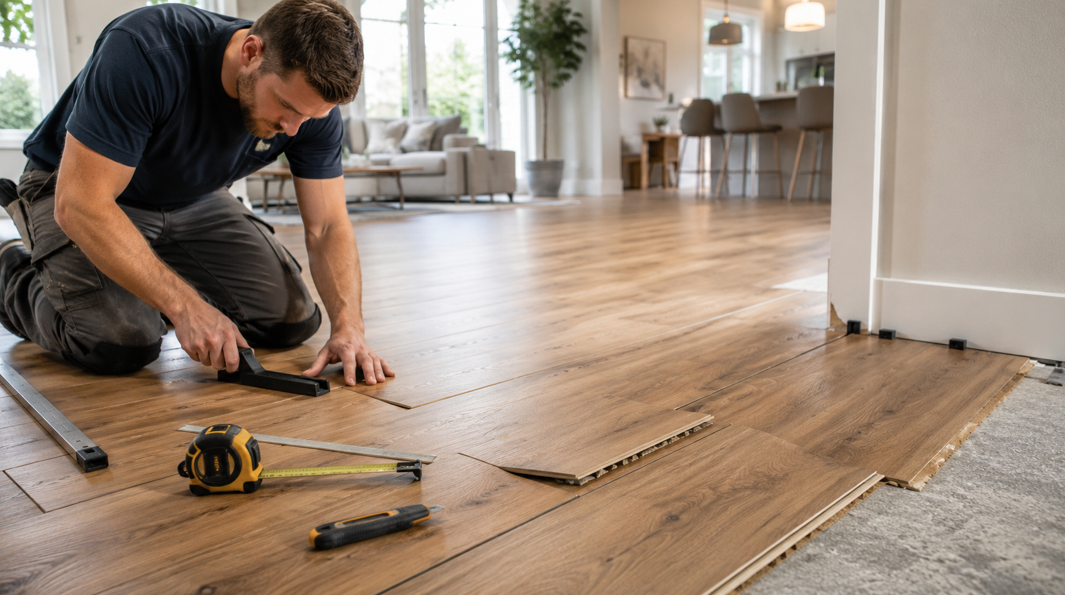
A Great Luxury Vinyl Floor Starts Before the First Plank Goes Down
Luxury vinyl flooring has become a popular choice for busy homes because it combines realistic wood or stone visuals with practical everyday performance. It can work beautifully in kitchens, family rooms, entryways, bedrooms, and many other spaces where homeowners want style without an overly demanding care routine.
But even a high-quality product can disappoint if the installation underneath it is not right.
For homeowners in Apex and Fuquay-Varina, that makes installation planning just as important as choosing the color, plank width, or pattern. New construction, remodeling, concrete slabs, existing flooring, room transitions, and changing indoor conditions can all affect how a luxury vinyl floor needs to be installed.
At The Home Center, we help homeowners pair attractive flooring with the right installation approach for the space. That matters because luxury vinyl is not one single construction or installation system. The Resilient Floor Covering Institute identifies three common LVT/LVP installation methods: glue-down, floating click-lock, and loose-lay. Each comes with its own requirements.
The biggest installation mistakes usually happen when someone treats those requirements as interchangeable. Skipping subfloor prep, guessing at expansion space, using the wrong underlayment, or assuming every product needs the same acclimation can create avoidable problems later.
Here are the installation errors worth watching for before your next luxury vinyl project.
Mistake 1: Treating Every Luxury Vinyl Product the Same
The term “luxury vinyl” covers a broad group of products. Some planks are flexible and designed to be glued directly to the subfloor. Others have rigid cores and locking edges that create a floating floor. Some products may use loose-lay installation methods.
That difference is not just technical wording. It changes how the floor needs to be prepared, installed, and finished.
Why the Installation Method Matters
A glue-down floor depends heavily on the condition of the surface and the correct adhesive. A floating floor needs room to move as a connected system. Loose-lay products have their own requirements for perimeter treatment, substrate condition, and room size.
RFCI explains that flexible LVT/LVP can be installed as dry-back or glue-down flooring, as a floating system, or as loose-lay flooring. Rigid-core products are commonly installed as floating floors using locking systems, but manufacturer requirements still govern the installation.
Before any work begins, identify:
The exact product and collection
Whether it is flexible or rigid-core
The approved installation method
The approved substrates
Whether a separate underlayment is allowed or required
Required expansion space
Temperature and jobsite requirements
Product-specific moisture limits or testing instructions
Avoid relying on installation habits from a previous floor. A method that worked for one luxury vinyl product may not be approved for another.
Mistake 2: Skipping Proper Subfloor Preparation
A new floor can only perform as well as the surface beneath it allows.
One of the most common installation shortcuts is assuming luxury vinyl will hide an uneven, damaged, dirty, or poorly prepared subfloor. Rigid-core products can sometimes tolerate minor substrate variation better than flexible materials, but that does not eliminate preparation requirements.
Shaw calls proper subfloor preparation one of the keys to successful luxury vinyl installation and specifically warns against skipping it. It also notes that an existing floor may sometimes remain in place only when the surface is flat, clean, and in good condition and the applicable installation instructions allow it.
Check Flatness, Cleanliness, and Stability
Before installation, the substrate may need to be checked for:
High spots
Low areas
Cracks or damage
Loose material
Old adhesive residue
Debris
Contaminants
Movement or squeaks in wood-based subfloors
Uneven transitions between rooms
“Flat” is not the same as “level.” A floor can slope slightly and still meet a manufacturer’s flatness requirement, while a floor that looks level may have humps or dips that create trouble.
The exact tolerance is product-specific. Use the flooring manufacturer’s installation instructions rather than applying a generic number to every project.
Why Small Irregularities Matter
On flexible glue-down vinyl, imperfections beneath the surface can become visible through the finished flooring. On click-lock flooring, excessive movement over dips or high points can place unnecessary stress on locking joints.
Good preparation may not be the most visible part of the project, but it is one of the most valuable.
Mistake 3: Assuming “Waterproof” Means Subfloor Moisture Does Not Matter
Many luxury vinyl products are marketed for strong water performance, and that is one reason homeowners consider them for kitchens, laundry rooms, and other active spaces.
That does not mean moisture conditions below the flooring can be ignored.
A product’s resistance to spills from above is a different question from whether the substrate and installation system meet the manufacturer’s requirements. Concrete slabs, adhesives, vapor transmission, and site conditions still need to be evaluated as directed by the product instructions.
Pay Particular Attention to Concrete
This can be relevant in new construction and slab-on-grade homes around Apex and Fuquay-Varina.
Before installation over concrete, the installer needs to follow the flooring manufacturer’s requirements for the substrate. Depending on the product and installation method, that may include approved moisture testing, surface preparation, vapor-control measures, or a specified adhesive system.
Do not assume a newly poured slab is ready simply because it looks dry on the surface.
Water Resistance Is Not a Substitute for Jobsite Evaluation
RFCI notes that moisture performance is an important consideration in resilient flooring systems, while Shaw’s installation guidance emphasizes that the subfloor needs to meet the applicable preparation requirements before the floor goes down.
The practical rule is simple: evaluate moisture according to the specific flooring system instead of using the word “waterproof” as permission to skip that step.
Mistake 4: Guessing About Acclimation and Indoor Conditions
You may have heard that every box of flooring needs to sit in the house for a certain number of hours before installation. That is another area where blanket advice can create confusion.
Some modern luxury vinyl products require acclimation under specified conditions. Others may not require a traditional acclimation period at all.
Shaw, for example, states in its general luxury vinyl installation guidance that acclimation is not required for the products covered there, but the flooring still needs to be installed in a climate-controlled environment. It also directs installers to product-specific installation documents because procedures vary by flooring type.
Follow the Product, Not a Rule of Thumb
Before installation, confirm:
Required room temperature
Required subfloor temperature, if specified
Whether permanent HVAC needs to be operating
Whether cartons require acclimation
Storage requirements
Conditions required during and after installation
This is particularly relevant during a North Carolina summer, when flooring may move from a hot vehicle, garage, warehouse, or construction site into an air-conditioned home.
Do not invent an acclimation period. Follow the instructions supplied for the exact product.
Mistake 5: Adding the Wrong Underlayment
Underlayment sounds like an easy upgrade. More cushioning and sound control may seem automatically better, but adding an extra layer beneath luxury vinyl without checking compatibility can be a mistake.
Some floors include an attached pad. Some allow a specific separate underlayment. Other installations may not need one at all.
Shaw explicitly advises homeowners to discuss underlayment when purchasing luxury vinyl because not every floor requires it.
Why Compatibility Matters
An unapproved underlayment may change how a locking floor moves under load or how the joints are supported. In other situations, a specific underlayment may be useful for sound absorption or moisture-vapor control.
The right question is not “Would extra padding be nice?” It is “What does this flooring system allow?”
When shopping for luxury vinyl flooring, ask how the selected product is constructed and what the installation instructions specify for the subfloor in your home. That keeps the material choice and installation system working together instead of treating them as separate decisions.
Mistake 6: Forgetting Expansion Space Around a Floating Floor
Floating luxury vinyl is connected to itself rather than fastened across the entire floor to the substrate. Because of that, the system generally needs the perimeter space specified by the manufacturer.
One common error is fitting planks too tightly against walls, cabinets, door frames, pipes, islands, or other fixed objects.
Shaw’s current luxury vinyl installation guidance tells installers to leave the required expansion space around the perimeter and fixed objects, and notes that the amount varies by the type of luxury vinyl being installed.
Do Not Guess the Gap
The required space can vary by product, room configuration, and installation instructions. Rather than relying on a universal measurement, confirm the requirement for the specific floor.
Pay attention around:
Walls
Door casings
Columns
Pipes
Stair components
Fireplace surrounds
Fixed cabinetry or islands
Other permanent vertical obstructions
Baseboards, shoe molding, or approved trim can cover the perimeter space after installation without preventing the floor from moving as designed.
Transitions Are More Than Decoration
Transitions can help protect exposed flooring edges and provide a finished change between rooms or flooring materials. Shaw notes that transition strips can protect plank edges as well as improve the finished appearance.
Use the trim and transition approach approved for the specific product and layout.
Mistake 7: Rushing the Layout and Plank Selection
Installation quality is not only about what happens under the floor. The visual layout matters too.
Opening one carton at a time and installing every plank in the order it appears can create clusters of similar patterns or tones. Starting without checking the room layout may also leave narrow cuts in highly visible areas.
Shaw recommends inspecting luxury vinyl for visible defects before installation and working from multiple cartons to help create a more uniform appearance.
Plan the Room Before Cutting
A careful layout considers:
The main sightline when entering
Plank direction
Room dimensions
Width of the first and final rows
Pattern repetition
Transitions into adjoining rooms
Doorways and irregular walls
Natural variation between cartons
Luxury vinyl is designed to reproduce the look of natural materials. Thoughtful mixing helps that variation look intentional.
Inspect Before Installation
Check boards or tiles under good lighting. Set aside pieces with visible concerns rather than installing them and hoping they disappear once the room is furnished.
This is also a good time to verify that cartons match the ordered product, color, size, and other identifying information required by the manufacturer.
Mistake 8: Forcing Click-Lock Joints or Using the Wrong Tools
Click-lock flooring can look straightforward, which is part of its appeal. But the locking edges are precision components.
If a plank does not engage correctly, forcing it into place can damage the joint rather than solve the problem. Dirt in the locking profile, an angled plank, an uneven subfloor, or the wrong installation sequence may be the real issue.
Use the tools and engagement method approved by the flooring manufacturer. Do not improvise with excessive hammering or assume every locking system works the same way.
Shaw’s installation guidance specifically advises DIY installers to consult the installation documents and gather the correct tools rather than taking shortcuts.
Watch the Installed Rows as You Work
Check regularly for:
Gaps between planks
Raised joints
Damaged edges
Rows drifting out of alignment
Pattern issues
Movement over uneven substrate areas
Finding a problem after two rows is easier to address than discovering it after an entire room has been completed.
Mistake 9: Assuming Existing Flooring Is Always a Suitable Base
Luxury vinyl can sometimes be installed over an existing hard surface, but “sometimes” is the important word.
The existing material still needs to meet the product requirements. Shaw states that LVT or LVP can be installed over existing flooring in many cases when the existing surface is flat, clean, and in good condition, but the installation guidelines need to be followed.
Before leaving an existing floor in place, consider:
Whether the manufacturer approves that substrate
Whether the surface is firmly bonded
Whether damaged sections need repair
Whether height changes will affect doors or appliances
Whether embossing, grout lines, or irregularities need treatment
Whether moisture concerns are present
Whether the existing material or adhesive requires special handling
Older flooring materials can also raise additional removal and safety considerations. If the existing material is unknown, avoid aggressive demolition until it has been properly evaluated.
Mistake 10: Treating Professional Installation as an Afterthought
Luxury vinyl is often described as DIY-friendly, and some products are designed with straightforward installation systems. That does not mean every room is a simple DIY project.
Large spaces, complicated layouts, concrete slabs, transitions, stairs, moisture concerns, subfloor repairs, glue-down installations, and new construction can all add variables.
Mannington strongly recommends trained professional installers for the best long-term performance of its ADURA luxury vinyl products and directs installers to follow the applicable installation guidelines.
A professional installer can evaluate the whole system rather than only the planks. That includes preparation, layout, transitions, substrate conditions, approved accessories, and finishing details.
For homeowners, that can make the installation experience more predictable and help the finished floor look as polished as the material deserves.
Build the Installation Around the Floor You Actually Chose
The most important luxury vinyl installation lesson is not a special trick. It is product-specific preparation.
Avoid assuming that every luxury vinyl plank acclimates the same way, needs the same underlayment, uses the same perimeter gap, or can go over the same existing surfaces. Flexible glue-down, floating click-lock, loose-lay, and rigid-core floors may share a category name, but they are not interchangeable installation systems.
For a smoother project:
Read the exact manufacturer instructions before work begins.
Confirm the installation method.
Prepare the subfloor properly.
Address applicable moisture requirements.
Maintain the specified jobsite conditions.
Use only approved underlayment and accessories.
Leave the required expansion space for floating installations.
Inspect and mix material before installing it.
Plan transitions and finishing details in advance.
Bring in experienced installation help when the project calls for it.
RFCI emphasizes that manufacturer requirements for flatness, expansion space, moisture, and underlayment still govern rigid-core installations, even though these products may tolerate some substrate variation better than flexible flooring. That is a useful principle for the entire category: let the selected flooring system determine the installation.
If you are planning luxury vinyl for a new home or remodel in Apex, Fuquay-Varina, or Holly Springs, get in touch with The Home Center. Our experienced team can help you choose beautiful, durable flooring and coordinate the details needed for a professional, finished result.


