

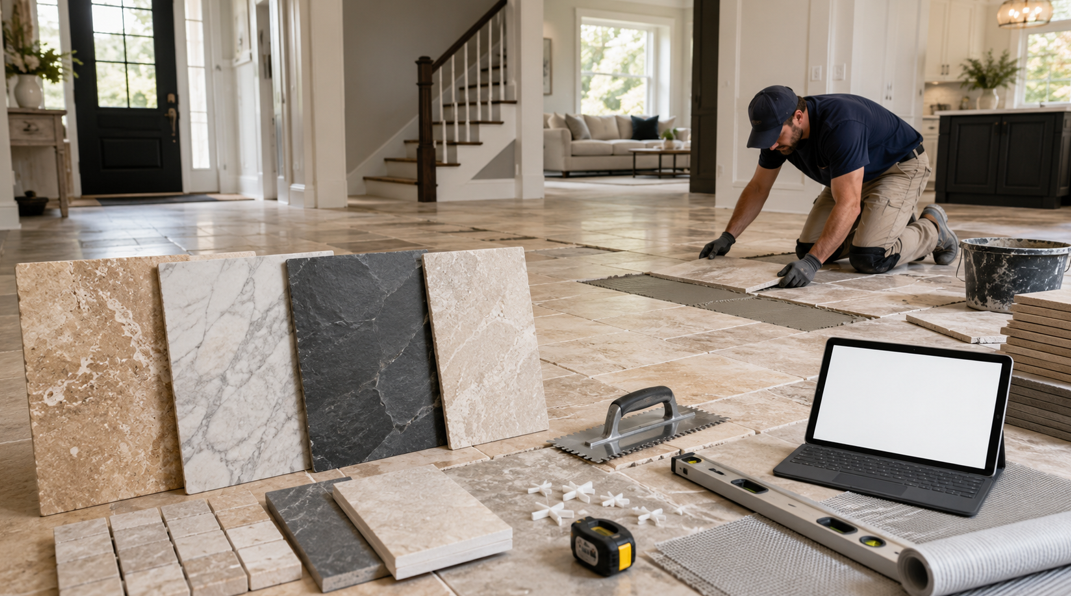
Build a Natural Stone Budget around the Entire Project
Natural stone flooring can bring lasting character to an entryway, kitchen, bathroom, mudroom, or other carefully selected area of the home. Every piece has natural variation, giving the finished surface depth and individuality that manufactured materials may not fully reproduce.
The tile itself, however, is only one part of the investment. A reliable budget also accounts for labor, surface preparation, removal of existing flooring, setting materials, grout, sealers, transitions, delivery, waste, and possible repairs beneath the finished floor.
At The Home Center, homeowners can compare flooring materials with help from experienced design professionals who understand how appearance, application, installation, and budget fit together.
For Holly Springs homeowners, natural stone installation costs can vary significantly from one project to another. The size of the room matters, but so do the stone type, tile dimensions, layout, condition of the subfloor, number of cuts, and level of preparation required.
A useful budget is not built around the lowest advertised price per square foot. It is based on the complete scope of work.
What Does Natural Stone Flooring Cost in 2026?
National cost data provides a starting point, but it cannot replace a project-specific local estimate. Current 2026 figures place natural stone tile materials across a broad range, commonly around $5 to $45 per square foot, depending on stone type, grade, finish, size, and source. Labor for general tile installation may range from approximately $3 to $15 per square foot, with more detailed stone projects potentially costing more.
Recent national estimates place many complete natural stone flooring projects between roughly $915 and $3,090, while additional preparation, removal, moisture control, or subfloor work may add hundreds or thousands of dollars. These figures are broad averages rather than guaranteed Holly Springs prices.
Natural stone may sit toward the higher end of the flooring market because it requires thoughtful material selection and careful installation. A basic rectangular room with a level surface and a straightforward pattern will usually be more predictable than a bathroom with several corners, plumbing penetrations, transitions, or decorative details.
Your final estimate may include:
Natural stone tile
Additional tile for cuts and future repairs
Delivery or handling
Removal and disposal of existing flooring
Subfloor inspection and preparation
Leveling or repair work
Underlayment or an uncoupling system
Moisture-control materials where required
Mortar, grout, and sealant
Labor for layout, cutting, setting, and finishing
Baseboards, trim, thresholds, or transitions
Furniture or appliance movement
Cleanup and final inspection
Ask for an estimate that clearly separates these components. That makes it easier to understand where the money is going and compare proposals fairly.
How the Type of Stone Affects Material Costs
“Natural stone” is not one uniform product category. Marble, granite, slate, limestone, and travertine have different appearances, performance characteristics, maintenance needs, and price ranges.
Marble
Marble is known for distinctive veining and an elegant appearance. It can create a striking bathroom, foyer, or other feature area, but its cost can rise based on color, origin, grade, finish, tile size, and pattern consistency.
Some marble is more sensitive to scratching, staining, etching, or moisture than other flooring materials. The stone may require suitable sealing and carefully selected cleaning products.
Marble with dramatic veining can also require additional planning. Installers may spend more time arranging pieces so the finished floor has an intentional flow rather than random visual breaks.
Granite
Granite is dense and available in many colors and patterns. Material costs vary widely, with certain colors and finishes priced higher because of availability, sourcing, or fabrication requirements.
Its density may make cutting more time-consuming, particularly around doorways, vents, cabinetry, or irregular room edges. Specialized tools and blades may be needed to achieve clean results.
Slate
Slate offers natural color variation and a textured, grounded appearance. It can work well in rustic, transitional, or nature-inspired homes.
Some slate products have more variation in thickness or surface texture than others. That may increase installation time because each piece needs to be evaluated and set carefully to create a comfortable, balanced surface.
Travertine
Travertine has a warm, classic appearance and may be available in filled, unfilled, honed, brushed, or tumbled finishes.
Open pores or surface voids may affect installation and maintenance. Homeowners benefit from understanding how the product is finished, whether it requires sealing, and how it will perform in the intended space.
Limestone
Limestone often has soft, neutral coloring that complements many Holly Springs interiors. Its understated appearance works well with warm wood, painted cabinetry, and other natural finishes.
Because limestone can be porous, the exact product and application deserve careful evaluation. Finish, density, sealing requirements, and traffic levels can influence long-term care.
Tile Size, Finish, and Grade Can Change the Price
Two tiles made from the same type of stone may have very different price points.
Tile Dimensions
Large-format stone can create a clean, spacious look with fewer grout lines. It may also require a particularly flat surface, careful handling, appropriate mortar coverage, and specialized cutting equipment.
Small tiles or mosaics may cost more per square foot and take longer to install because they involve more pieces and grout lines.
Surface Finish
Common finishes include:
Polished
Honed
Tumbled
Brushed
Textured
Flamed
A polished finish reflects more light and may emphasize color and veining. A honed finish generally looks softer and more matte. Tumbled or brushed surfaces can create an aged or textured appearance.
The finish also affects traction, maintenance, and suitability for a specific room. Product selection should consider more than appearance alone.
Stone Grade and Visual Consistency
Natural stone commonly includes variation in color, veining, texture, mineral markings, and pattern. Some products are sorted to create greater consistency, while others celebrate a broader natural range.
Premium grades, limited colors, imported selections, or tightly matched lots may carry higher prices. Review several pieces rather than choosing from one sample so you understand the likely variation.
Why Additional Material Needs to Be Included
Ordering exactly the measured square footage is rarely enough. Extra material is commonly required for cuts, breakage, pattern alignment, natural variation, and future repairs.
General tile guidance often recommends ordering approximately 10% to 15% more material than the measured area, although complex patterns or irregular rooms may require a larger allowance.
A simple rectangular room with a straight layout may produce less waste than:
A diagonal installation
A herringbone or decorative pattern
A room with several corners
A floor with multiple doorways
A design using borders or insets
A project that requires selective placement of veining
Keeping a few unused pieces after installation can be valuable. Natural stone lots vary, and finding an exact match years later may not be possible.
Labor Is More Than Placing Tile on the Floor
Professional labor includes several stages that may not be obvious when looking at a completed floor.
Homeowners can explore natural stone flooring options while considering how the size, finish, pattern, and intended room may affect installation requirements.
Measuring and Planning
The installer needs to confirm the usable square footage, identify transitions, examine door clearances, and plan where full and cut tiles will fall.
A carefully planned layout can prevent narrow pieces from appearing in prominent locations and help natural patterns move through the room in a balanced way.
Sorting the Stone
Because stone naturally varies, installers may open several boxes and blend pieces before setting them. This distributes color, veining, and texture across the room.
Some pieces may be reserved for less visible areas, while especially attractive tiles may be positioned in focal points.
Cutting and Fitting
Stone may be harder or more delicate to cut than standard ceramic tile. Clean cuts around walls, cabinets, vents, plumbing, and thresholds require suitable equipment and experience.
More corners and penetrations generally mean more labor.
Setting and Leveling
The installer needs to achieve appropriate mortar coverage while keeping the surface aligned. Variations in tile thickness can require additional adjustment.
Large-format pieces and naturally uneven stone often need extra care to limit noticeable height differences between adjacent tiles.
Grouting and Finishing
Grout color, joint width, cleanup, sealing, and transition details affect the final appearance. Certain stones may need protection before grouting to reduce the risk of pigment or residue affecting the surface.
These steps explain why two rooms with the same square footage can receive different labor estimates.
Surface Preparation Can Be a Major Cost
The visible flooring is only as dependable as the surface beneath it. Natural stone is rigid and can be less forgiving of movement, unevenness, or inadequate structural support.
Current 2026 tile cost guidance places routine cleaning and surface preparation around $1 to $5 per square foot in some projects, with extensive repairs or replacement costing more.
Removing the Existing Floor
Removal costs depend on what is already installed. Carpet may be faster to remove than bonded tile, thick mortar beds, or multiple flooring layers.
The estimate may include:
Demolition labor
Adhesive or mortar removal
Nails, staples, or fastener removal
Debris hauling
Disposal charges
Baseboard removal and reinstallation
Do not assume removal is included unless it appears in writing.
Inspecting the Subfloor
Once the old flooring is removed, the installer can evaluate the surface more accurately. Hidden issues may include soft areas, water damage, loose panels, cracks, uneven seams, or previous repairs.
Some problems cannot be priced precisely before demolition. A proposal may include an allowance or explain how unexpected repairs will be handled.
Leveling and Flattening
A floor can be structurally sound yet still be too uneven for the selected tile. Low spots, ridges, or abrupt changes may require patching, grinding, or leveling materials.
Large stone tiles generally make surface irregularities more noticeable, so preparation may be especially important.
Underlayment and Movement Control
The installation system may require backer board, an uncoupling membrane, reinforcement, or another approved substrate.
The correct approach depends on the structure, stone, room, manufacturer instructions, and applicable installation standards. These materials add cost but serve an important role within the complete system.
Moisture Considerations
Bathrooms, laundry rooms, entryways, and certain concrete surfaces may need additional moisture evaluation or protection.
This may involve waterproofing, crack isolation, vapor management, or other materials selected for the project conditions. A qualified installer can explain what is included and why.
Layout Choices That May Increase Labor Costs
Natural stone makes patterns especially noticeable because every piece is unique. The layout can either simplify the project or add significant time.
Straight Lay
A straight layout is often the most efficient option. Tiles align with the room’s walls, and the pattern is relatively simple to plan.
This does not guarantee a low price, but it may reduce complicated cuts and layout time.
Diagonal Lay
Turning the tile at an angle can make a room feel more dynamic. It also creates additional perimeter cuts and may increase waste.
Herringbone and Other Patterns
Herringbone, basketweave, pinwheel, or custom patterns require more layout work and precision. Mosaics may arrive on sheets, but alignment still needs careful attention.
Borders and Insets
A contrasting border, medallion, or decorative inset can create a distinctive floor. It may also require additional products, detailed measurements, specialized cuts, and more installation time.
Vein Matching
Certain marble and limestone selections may be arranged to create a flowing or mirrored effect. This can elevate the design, but it requires extra material, sorting, planning, and labor.
Create a Simple Project Budget
A useful planning budget can be divided into four categories.
1. Materials
Include:
Stone tile
Waste allowance
Mortar
Grout
Sealer
Underlayment
Trim and transitions
Delivery
Do not calculate the tile cost from room dimensions alone. Confirm the actual order quantity after accounting for the layout and waste.
2. Installation Labor
Ask whether the labor estimate includes:
Layout
Material sorting
Cutting
Setting
Grouting
Sealing
Final cleaning
Baseboards or trim
Appliance movement
Cleanup
A lower labor figure may cover fewer services, so compare scope rather than price alone.
3. Preparation
Set aside funds for:
Existing floor removal
Disposal
Adhesive removal
Subfloor repair
Leveling
Underlayment
Moisture or crack-control systems
Preparation is one of the most common reasons an early estimate changes after demolition.
4. Contingency
A contingency provides room for conditions that were not visible before work began.
For a straightforward project with an exposed, well-understood surface, the contingency may be modest. For an older floor, previous leak area, multiple flooring layers, or complex renovation, a larger allowance may be sensible.
The contingency is not a prediction that something will go wrong. It simply creates a more comfortable plan if hidden work becomes necessary.
Example Budget for a 150-Square-Foot Room
Consider a hypothetical 150-square-foot room in a Holly Springs home.
If the layout requires a 10% waste allowance, the homeowner would order approximately 165 square feet of stone. At a hypothetical material price of $12 per square foot, the stone itself would cost about $1,980.
A planning calculation might include:
Stone tile: $1,980
Setting materials, grout, and sealer: $300 to $650
Installation labor: $1,200 to $2,250
Removal and disposal: $300 to $900
Surface preparation: $300 to $1,200
Trim, transitions, and delivery: $200 to $600
Contingency: based on project risk
That produces a broad planning range of approximately $4,280 to $7,580 before contingency.
This is an illustrative example, not a quote or a prediction of local pricing. The actual total could be lower or higher depending on the selected stone, existing floor, pattern, access, preparation, installation system, and contractor scope.
The most important lesson is that a $1,980 tile order does not represent a $1,980 completed floor.
Ways to Keep the Budget Focused
Natural stone does not need to be the least expensive flooring choice to provide good value. The goal is to make intentional decisions and avoid paying for details that do not support the design.
Use Stone Where It Has the Most Impact
Instead of installing stone throughout several rooms, consider using it in a foyer, powder room, bathroom, fireplace area, or another focused space.
Choose a Straightforward Layout
A straight pattern can reduce cuts, waste, and layout time while allowing the natural material to remain the main visual feature.
Select an In-Stock or Readily Available Stone
Special orders, rare colors, and imported products may increase material, freight, and replacement costs. Ask about availability and lead times before finalizing the selection.
Coordinate the Design Early
Choose the stone alongside cabinetry, countertops, paint, fixtures, and adjoining flooring. Late changes can create restocking fees, scheduling delays, or transition problems.
Protect the Preparation Budget
Reducing preparation below what the installation requires may create poor long-term value. It is usually wiser to simplify the pattern or select a different stone than to overlook the substrate.
Request a Detailed Estimate
A clear estimate makes it easier to identify allowances, exclusions, and optional upgrades. Ask questions before work begins rather than relying on assumptions.
Questions to Ask before Approving an Estimate
Use these questions when reviewing the project:
Does the price include the natural stone itself?
How much extra material is being ordered?
Is delivery included?
Does the estimate include removal and disposal?
What preparation is assumed?
How will hidden subfloor repairs be priced?
Is underlayment or a membrane included?
Are mortar, grout, and sealant included?
Does the stone need sealing before or after grouting?
Are baseboards, trim, and transitions included?
Who moves appliances or furniture?
What pattern and grout-joint size are included?
Is final cleanup included?
What product and installation warranties apply?
How should the finished stone be maintained?
The answers help establish whether an estimate is complete and whether each contractor is pricing the same project.
Plan for Beauty, Preparation, and Long-Term Value
A natural stone budget has three major parts: the material you see, the professional labor that shapes it, and the preparation that supports it. Focusing only on the tile price can leave a large gap between the expected total and the final scope.
Holly Springs homeowners can create a more reliable plan by confirming the stone type, measuring accurately, including waste, selecting the layout early, and having the existing surface evaluated. A detailed estimate should explain removal, preparation, installation materials, labor, finishing, and possible additional work.
The Home Center serves homeowners and builders in Holly Springs, Apex, and Fuquay-Varina with product selection, design guidance, and coordinated installation support. The Holly Springs showroom currently operates by appointment, with access focused on new-construction appointments, so call ahead before planning a visit.
Ready to discuss natural stone flooring and build a project-specific budget? Get in touch with The Home Center to arrange an appointment.


